For people who use the services of financial advisors (also referred to as Private Banking Relationship Managers or Financial Consultants or Wealth Managers), it would seem odd that not one of them have actually advised the client to "hold on" to cash especially when there are not enough opportunities to invest in the markets or sure-shot stock picks. Often, the relationship managers find enough reasons to stash off this idle money in a single-premium insurance policy or a debt mutual fund or is an 'under-valued' sectoral mutual fund.
The only explanation I could come up for this is, conflict of interest. A relationship manager earns his fees (revenue for the bank) by getting clients invested in various financial products. He might view cash as a wasted opportunity for personal gain, although it might be in the client's best interest to show restraint in investing (esp. during tumulus times like these). Likewise, an RM will be eager to sell you an insurance policy as opposed to a mutual fund - as the former gives him a 30% commission as opposed to a meagre 2% commission for mutual fund investments.
Which makes me wonder - aren't research houses also in the same business? Isn't it in the interest of brokerage houses to inflate stock recommendations - so that investors put their money in the stock through their brokerage channel? At about 0.1% (average of delivery / intra-trade) for every rupee invested, a stock recommendation holds a lot of value. Motilal Oswal (here) has over 400,000 retail clients today and does broking revenue (FY2008) of 562 crores. Taking a ballpark of 0.1% revenue per rupee trade, they do about Rs. 562,000 crores of trades in a year (or Rs. 2,300 crores per day).
I would additionally suggest a reading of the latest Roger Lowenstein article on Moody's published in the NY Times (here).
The scribe starts off with an apt remark by Thomas Friedman in 1996 : "There were two superpowers in the world — the United States and Moody’s bond-rating service — and it was sometimes unclear which was more powerful.". (We now know who turned out the superior one !)
The article takes a hard look at how Moody's evaluated mortgages bundled as securities and assigned a rating to it. It also talks extensively of the mistakes they made in valuation of these securities and how the market crumbled due to lack of foresight, greed and trasparency (well, the lack of it). There is also a paragraph on conflict of interest - where rating industry's closeness with banks (whose securities they rate), often distorts their assessment of the instrument.
Wednesday, April 23, 2008
Conflict of Interest & Credit Rating agencies

Bookmark this post: | 


|
Tuesday, April 22, 2008
Boiler Room
Boiler rooms operations are nothing but share scams. The stock operator will sell worthless shares at inflated prices to investors that are impossible to sell. (seems like a script from "Not a Penny More, Not a Penny Less", doesn't it?)
Here's how it works :
1. A broker, usually operating from an overseas firm, will cold call an investor and propose they buy shares in a particular company.
2. To avoid being ill prepared for the nosy web-savvy investor, the share would usually have been ramped on online message boards.
3. The company they are share dealing in will probably be - a) listed on an illiquid market or, b) could be a small, unquoted company that the broker claims is planning to list
4. So, one of two things will happen - a) the shares cannot be sold as there is hardly a market for it or, b) the company will not exist at all and the broker is simply selling shares in thin air before taking the money and running (extreme case)
The firms operate from boiler room 'hotspots', such as Spain, Switzerland, Dubai, Japan, Bermuda etc. They will always have a listed address and a grand sounding name to give an air of legitimacy.
These are called 'boiler room' scams because of the highly pressurised sales technique employed by the broker. They can be forceful, persistent and highly aggressive. A common tactic is to create a sense of urgency about a stock, such as telling the investor it will explode any day so they need to invest quickly.
Additional resource : The boiler room boys are back with a new 'bargain' (here)
Bookmark this post: |
|
Monday, April 14, 2008
The economics of a tip
Most trading in the Indian equity markets still happen on tips, news and advice from brokers. The stock market absolutely craves tip-o-logy as it ensures that the greater fool theory works fine. For a value investor, these tips are suicide ... unresearched and risk-heavy. As Wareen Buffett once said, "Even an insider's tip can be wrong".
Interestingly, the only person who is absolutely sure to gain from a tip is the "tip giver". Take a look at this -
Day 1
You wake up and go through your rather extensive phone book. There are exactly 1000 mobile numbers. Not worrying about the day's valuations or what Udayan Mukherjee has to say on CNBC TV18 or the latest scoop in moneycontrol.com ... you start by neatly dividing the stock of mobile numbers in two equal parts. Then you start the rather laborious exercise of sending a message to the first 500 people - "Reliance Industries will go up today" and to the other 500 people - "Reliance Industries will go down today". Your cost = 1000 rupees (Re.1 being the charge of an SMS)
Day 2
Another wonderful morning. You pick up the morning paper to find the Reliance stock to have shot up. You look to the skies, say a small pray for the people who got your prediction wrong and get about your work for the day. You divide the remaining stock of 500 people who got the right 'advice' into two parts. To one part (250) you sms - "Infosys is definitely up today" and to the remaining 250 - "Infosys is surely down today". Your cost = 500 rupees (total cost = 1500)
Day 3
Infosys seems to have gone down today.. these cut in spends in the US are creating some havoc, you say and get down to business. 250 correct tips (for two days) get cut in 125 and 125. To one half, Wipro to go up and to the other, Wipro to go down. Cost for the day = 250 rupees
Day 4125 is broken into 62/62. Now HLL is at stake, and you have me (the famous stock analyst) to give you your daily sms stock tip. Cost = 125; total cost = 1875
Day 5
By now these 62 people who got all 4 tips correct would be really going nuts. Some might have also invested using my tips while some others would be really scouting for some money because they now have this amazing stock analyst who gives correct predictions after another. For them equity market investing was never so much fun and easy.
Only this time it's pay-back time. In return of these wonderful tips, I ask for a paltry sum of rupees 10 for the next tip. Let assume the 62 of them pay up 10 rupees. Thats a cost of 62 for me (for the sms) but an earning of 620 rupees. Total loss is now down to 1,317 rupees. Again we do the 31/31 split.
Day 631 is split as 16/16 (rounding off numbers here for illustration purposes). This time I charge a premium of 20 rupees because its 5 correct tips in a row.
Day 7, day 8, day 9 and day 10
16 = 8/8; 8= 4/4; 4=2/2; 2=1/1
Premiums also increase to 30, 40, 50 and 60 rupees. I am currently sitting on a cumulative profit of 362 rupees.
Day 11
Last day at work. I pick up my phone for a rather lackluster day, flip a coin and sms the one lonely fellow my tip of the day (boy, this guys must have gone real crazy by now). He must be eyeing an expensive lunch table with Warren Buffett. Not even, Buffett might have got 11 bets right in 11 straight days .. afterall, he is a lame value investor.
At the end of 11 days of work the tip giver has a net PROFIT of 431 rupees.
Scenarios -
a) Had I started the share-tip collection in the fourth iteration itself, I would have made profit of 2921.
b) And if I had charged a premium of 10 rupees throughout from the fourth iteration - i would have gained 491 rupees.
The king of torts may ask - "Is it legal?". Well what makes any aspect of this illegal? The people receiving the tip have a choice to act or not act on it. Consideration is being taken for a service rendered - i.e. pain-staking research of Indian equities.
Excellent money making machine, eh? (Q.E.D.)
If you like this content, then do check out my new blog on investing and stock markets for lots more information on the Indian equity markets
(Story available on my previous blog. Just went down memory lane !)
Bookmark this post: |
|
Saturday, April 12, 2008
An article gone wrong
Fortune published an article in August 2000 with a bold title : "10 Stocks To Last The Decade". The article made an assessment of major trends that'll shape the next ten years .. and how their pick of 10 stocks are at the cutting edge of this change. In other words, Fortune advised investors to really invest i.e. build a buy-and-forget portfolio. Unfortunately one of these ten companies did not survive even 4 years since the article was published.
These 10 blockbuster companies, handpicked for long term investment, listed in the article were :
Broadcom
Charles Schwab
Enron
Genentech
Morgan Stanley
Nokia
Nortel Networks
Oracle
Univision
Viacom
And here are the results from the stock market, 7+ years since that article was published (here):
As a portfolio, these 10 stocks have eroded shareholder's wealth by a whooping 53% in a period of 7 years. The valuations of most stocks were faulty and were picked during periods of extreme optimism in the stock exchanges. Trading in these stocks was heavy and the price-earning multiple of each of these stocks (barring 1) was over 50. Imagine taking these stocks to Benjamin Graham or Warren Buffett for an assessment ! (while the first would have been furious, the latter would have been puzzled at the business which he didnt quite understand)
Bookmark this post: |
|
Investors emotive cycle and the credit crisis
In high school, we were introduced to economics and the cycle of Growth, Maturity, Slowdown, Depression & Revival. For centuries most businesses and industries have treaded from peaks to troughs. An investor's job is to identify the current cycle state of those businesses at the stock market and take an informed decision to invest or divest based on the valuations.
But these patterns are not just applicable for businesses or sectors. Infact, individual human behavior isn't any different at all. There are 5 behaviors that best describe an investor's state in the muddled financial markets - Greed, Disbelief, Denial, Fear, Anger.
While the first four are very prominent phases during financial crises, 'anger' is one behavior that seems to have taken over investors. George Soros is angry with the Federal Reserves; the Feds are livid over the PEs and hedge funds who bought mortgage-backed securities; these institutions are hurling abuses at rating agencies who incorrectly rated those tranches; the rating agencies are furious at the lack of data provided by banks offering these assets; these banks are blaming mortgage consumers; and the consumers blaming these banks for over-leveraging them; the banks are crying because the Feds increased interest rates thereby lowering prices of housing ... the blame game never ends. Everyone is angry !
Anger occurs when one's trust is violated. But who is to be blamed for this? Look at it this way, you wouldn't lend money to the nice family that lives 3 houses down the road. But you are comfortable lending it to an unregulated institution called a hedge fund. You have placed your trust (and money) on a stranger.
As an article in the Economist puts it (here), the financial market mostly works on trust. Regulators have to trust financial institutions for they cannot predict the peril of a financial idea before the peril has happened. They have to let markets develop. Incidentally, the credit crisis have called for a much higher participation by regulators. As Josef Ackermann, CEO of Deutsche Bank aptly puts it, "I no longer believe in the market's self-healing power".
While risk is always there while investing, as value investors our approach should be to minimize the impact of these risks. Like Charlie Munger who says, "build a 30,000 ton bridge for a 10,000 ton truck". He and Warren Buffett have also held that they are nervous investing in businesses which they dont understand. The mortgage crisis was similar because the complicated structures made it difficult to understand the nature and quality of the asset .. even today banks ad the central banks are not sure of the extent of the damage .. some say it can be as high as USD 30 trillion.
Bookmark this post: |
|
Tuesday, April 8, 2008
Make your luck !
Press your luck was an American television day-time show where contestants collected spins for answering trivia questions. These spins could then be used in a 18-space full of cash and prizes. The format of the game allowed for extra spins, double your money, big bucks and other variations. It also featured a "lose all your money" feature popularly called a Whammy (which everyone tried to avoid, obviously).
All was going fine, till a man named Michael Larson came over to the CBS studios in 1984. This self-described unemployed ice cream truck driver made quite an impression ... he played 45 consecutive times without hitting a second Whammy. In less than an hour, he earned a total of $110,237 in cash and prizes, a record for a single appearance on a daytime network game show up to that time. (the median for winners at shows was around $15,000 till then)
Luck? Nah !
Larson had watched the show at home and with the use of stop-motion on a VCR, he discovered that the presumed random patterns of the game board were not random, and was able to memorize the sequences to help him stop the board where and when he wanted.
The entire episode makes for an excellent read (here) ... and fun to watch (here)
Bookmark this post: |
|
Tuesday, April 1, 2008
Using mathematical models to find love
I first thought this would be some flashy book title by an obscure author, merely trying to sensationalize a rather naive, boring statistical approach. I was surprised to find that it was the internet behemoth, Google that had churned this research paper into a product. The application is currently in beta.
Interestingly, Google managed to find a way to commercialising this application with contextual advertising. The online dating market is estimated at over USD 2.3 billion. And as no new innovation has happened in this segment in the last 2 years, Google might be instrumental in reshaping the industry.
Access link : http://www.google.com/romance/
Bookmark this post: |
|
Sunday, May 20, 2007
Provisions & Prakash Industries
On the face of it, Prakash Industries seemed a good bet. The company has embarked on a number of cost saving initiatives and has improved profitability in multiple areas. The P/E of the scrip is around 4. The company has diversified into various businesses like power, wind energy etc. There is also a lingering news of a de-merger which could unlock more value for stockholders (which is primarily promoters).
However, the announcements page of BSE had one section which caught my attention. It seems the company has a penchant for "ignoring possible risks". Here's some important items the auditors pointed out -
1. No provision has been made in respect of doubtful / disputed debts, loans and advances aggregating to Rs 109 lacs
2. No provision has been made in respect of lease rental liabilities due to pending cases and settlement of disputes with the lessors, the amount whereof is not ascertainable.
3. No provisions for gratuity and leave encashment has been made, the amount whereof has not been ascertained. (Refer Note 7)
4. There is a lower charge of interest of Rs 563 lacs for the quarter (Rs 1668 lacs for the nine months period) ended December 31, 2006 for which the settlements with the concerned lenders are yet to be concluded.
5. No adjustment has been made in the accounts for the amount waived under settlements entered into during the year with financial institutions.
6. Adjustment has been made in the books of account towards Minimum Alternate Tax which may be set off against future tax liability of the Company. However, the auditors are unable to express any opinion on the Company’s ability in future for this set off. (Refer Note 13)
7. Provision for Deferred Tax Liability has not been made. Consequently, the profit for the quarter & the period ending December 31, 2006 has been shown higher by Rs 1387 lacs and Rs 3702 lacs respectively. (Refer Note 14)
8. No amount has been amortised towards Deferred revenue expenditure incurred during the year by the Company. (Refer Note 15)
These provisions can have a huge impact on the profitability of any company. Let's take two examples here -
1. Consider an insurance company. The perfect recipe for insolvency is the combination of aggressive (under) pricing and low reserving. The two underlying motives for this are - 1. expansion & increasing market share and, 2. inflating the profits. These short-term moves can really hurt the company when a serious claim hits them - and they find themselves out of money to settle the claim (Read the article on Insurance Company Failures for more info on this)
2. Frequent flyer miles given out by Airline companies. Currently, around 14 trillion miles have been unclaimed - this is a risk faced by all airline companies where they, as a group, have to quantify these 14 trillion miles and accommodate this liability in their accounting statements as a provision (reserves). American Airlines carries a USD 1.6 billion liability in it's books, in unclaimed miles. Interestingly, 7.5% of all customer who flew in the US, were on free trips. That's 7.5% less income for all airlines.
Im not comfortable with ivesting in Prakash Industries given these provisions. This is quite typical of a promoter-led organisation (promoters in the company have over 2/3rd ownership and public holding is just 15%).
Bookmark this post: |
|
Friday, May 18, 2007
Rational market?
Page 26, The Times of India, May 18th 2007 (Friday)
The short snippet in the top left of the page reads : Max India reports a loss of Rs. 3.82 crores.
The middle strip in the page which shows NSE TOP Gainers reads : Max (I) : 257.65 (an intra-day gain of 7.1%)
Further, in the last one week - the price of the share has increased from 204 to 260 rupees per share. Also, some major shareholders have increased their holdings in the company - Medicare and Maxopp Investments. Interestingly, Max India has given an announcement from the Board Meeting that they will not recommend any dividend for the year (obviously, due to the negative profits). The share price rose inspite of no-dividends.
On a business front, Max has primary interests in two fields - Insurance and Medical facilities. While the latter requires heavy capex, the former reaches break-even only in 5-6 years. Also the competition in insurance has been increasing and Max NewYork has to totally rely on agents (ICICI Prudential, SBI Life have a strong bancassurance base aswell). At annual sales of around 170 crs and net profits of 10 crs, the company is too small to vouch an interest in conservative investors like me.
But i'll sure like to know what the fuss is all about - why would people put extensive money on company which has just declared a loss for the quarter. Am I missing something?
Bookmark this post: |
|
Friday, May 11, 2007
Getting greedy
A common thread amongst all people reading this blog is the greed for earning more - to make every rupee count for more & beyond. Corporations are no different. To squeeze out every dollar of profits from the scarce capital base is a prime priority for small and big firms alike. A recent news article described how Walmart exploited a tax loophole to save taxes .... Article
The modus operandi was simple -
1. Walmart transfers the asset to an REIT which is largely controlled by a subsidiary of Walmart (REIT means a Real estate Investment Trust). The Walmart store then pays a rent to the REIT, which is tax deductible (Taxes saved - 1)
2. The REIT in turn pays dividend of the Walmart subsidiary which is 99% of the rental received. The rule says, if an REIT transfers most of it's earnings to it's shareholders as dividend then no tax is deducted on the amount (Taxes saved - 2)
3. The subsidiary in turn, transfers the monies received to the parent. The transfer of income from the subsidiary to the parent involves no taxes. (Taxes saved - 3)
The taxes saved in question is an incredible USD 2.3 billion !!!
Bookmark this post: |
|
Saturday, April 22, 2006
God knows why but my broker friend is extremely bullish on ...
In a recent post, Amit had penned the following comment :
Hello shankar,
My broker is extremely bullish on jHUNJHUNWALA VANASPATI.This stock has been hitting circuits for the past some time,the current market price(at todays circuit) is 58.He expects it to reach a three figure mark in a months time(atmost).
One other stock is UB enginerring trading at 63(todays circuit) which has also hit circuits almost daily in the past few days....
Will look forward for your advice on UB Engineering and JHUNJHUNWALA VANASPATI.
God knows what but my broker friend is extremly extremly bullish on JHUNJHUNWALA VANASPATI.
Best regards,
Amit.
Jhunjhunwala Vanaspati has risen from 40 rupees (Mar-28) to 65 rupees (Apr-21) - a return of 62.5% in 3 weeks [Charting]
On a more sanely and boring front, lets examine the financials of this scrip -
1. The stock is at a fwdPE of 6.12
2. Has been profitable over the last 5 yrs and all quarters are in the black (this isn't some small company .. it has sales of almost 500 crs)
3. Although quarterly profits are not high .. the company should close the yr with 10 crs of PAT
I would advice a small sum of money (not to be entirely taken as a gamble) ... towards this company. Keep a stop loss of 50 rupees however.
UB Engineering was at 32.95 (Mar-28) and has risen to 66.00 rupees (Apr-21) without a single day of negative returns .. one reason why Amit has not been able to lay his money on this stock [Charting]
UB Engineering has been posting losses for the last 4 yrs. One reason for recommending this stock can be the expectation that UB Engineering will be in the black this quarter like the previous one and perhaps actually, have had made some money. I would advice a "no buy" on this scrip.
Bookmark this post: |
|
Scrips I don't like
4 codes ... Buy / Wait / Pricey / Penny ... is what I use in my stock tracker.
Buy means an under-valued stock
Wait means a stock, fairly valued .. yet in contention if the price reduces
Pricey is a stock, over-valued and hence, not in contention yet
Penny is the scum-stock ... ones I'll stay away from for a long time
Here's a list of some I've classified as "Penny" (some changes may be done from this list on account of fundamental changes to the scrip) ... the primary reason for not investing in these stocks is the low profit levels exhibited by the below stocks
Silverline Technologies Ltd.
Tele Data Informatics Ltd.
Jindal Worldwide Ltd.
Shyam Telecom Ltd.
Vardhman Spinning and General Mills Ltd.
Saurashtra Cements Ltd.
Rain Commodities Ltd.
Morarjee Realties Ltd.
Selan Exploration Technology Ltd.
Prakash Industries Ltd.
Birla VXL Ltd.Mysore Cements Ltd.
Andhra Cements Ltd.
LML Ltd.
Moschip Semiconductor Technology Ltd.
Andrew Yule & Company Ltd.
IFCI Ltd.
Consolidated Finvest & Holdings Ltd.
FCGL Industries Ltd.
Sterling Holiday Resorts (I) Ltd.
Sharyans Resources Ltd.
Gujarat Sidhee Cement Ltd.
Swan Mills Ltd.
Premier Explosives Ltd.
Jay Shree Tea & Industries Ltd.
Ruby Mills Ltd.
Bhansali Engineering Polymers Ltd.
Mahindra Gesco Developers Ltd.
AVT Natural Products Ltd.
Suprajit Engineering Ltd.
J K Industries Ltd.
Agro Tech Foods Ltd.
Liberty Shoes Ltd.
Polyplex Corporation Ltd.
Sirpur Paper Mills Ltd.
Shriram Overseas Finance Ltd.
Gujarat Apollo Equipments Ltd.
Forbes Gokak Ltd.
Samkrg Pistons & Rings Ltd.
Himachal Futuristic Communications Ltd.
Empee Sugars and Chemicals Ltd.
Energy Development Company Ltd.
Aksh Optifibre Ltd.
ABG Heavy Industries Ltd.
UTV Software Communications Ltd.
Yokogawa India Ltd.Prime Securities Ltd.
Cyber Media (India) Ltd
Eimco Elecon (India) Ltd.
Harrisons Malayalam Ltd.
Kalyani Forge Ltd.
Venky''s (India) Ltd.
Revathi Equipment Ltd.
Standard Industries Ltd.
Sarla Polyester Ltd.
Themis Medicare Ltd.
Goodricke Group Ltd.
Ramco Systems Ltd.
Nesco Ltd.
Om Metals Ltd.
Z F Steering Gear (India) Ltd.
Texmaco Ltd.
Star Paper Mills Ltd.
Madhucon Projects Ltd.
Transgene Biotek Ltd.
Indian Hume Pipe Company Ltd.
Central India Polyesters Ltd.
Swaraj Mazda Ltd.
Anant Raj Industries Ltd.
Ondeo Nalco India Ltd.
Scooters India Ltd.
International Travel House Ltd.
State Trading Corporation Of India Ltd.
Megasoft Ltd.
Spel Semiconductor Ltd.
Saregama India Ltd.
Faze Three Ltd.
Eskay Kn''''''''IT (India) Ltd.
Kale Consultants Ltd.
Force Motors Ltd.
S B & T International Ltd.
Deepak Nitrate
Mather and Platt (India)
Excel Industries
Bharat Gears
Triton Valves
Liberty Phosphate
Advanced Micronics
Bookmark this post: |
|
Friday, March 17, 2006
What a tip !!!
A friend called up this evening to discuss a tip he received from his broker - Buy Ramco Systems. The reason being - the stock is at it's 52-wk low of 193 rupees and it's 52-wk high was a huge 519 rupees. He said, the stock had mighty upside as buying levels will increase. I checked out the numbers and was absolutely taken aback with the financials. Enjoy this !!!
a) The company has been in the red for six out of the last eight quarters
b) The P&L account of the company shown a loss for the last 4 financial years
c) Personnel expenses account for 40% of the total sales of the company
d) No dividend for the last 5 financial years (obviously)
But that's not the shocking part ....
Check the prices over these last eight quarters. I have taken the highest price within one month of the close of quarter (these are the times when the financial statements come out)
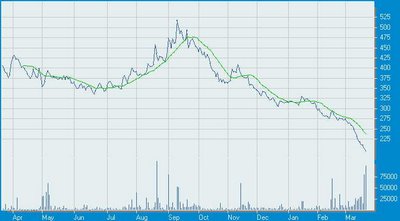
Mar-04: Profit of 4.21 crs; Price was 265 rupees
Jun-04: Loss of 9.29 crs; Price was 250 rupees
Sep-04: Profit of 2.32 crs; Price was 290 rupees (the price increased while profits dipped)
Dec-04: Loss of 3.36 crs; Price was 440 rupees (the price increased while profits dipped)
Mar-05: Loss of 30.04 crs; Price was 425 rupees
Jun-05: Loss of 6.03 crs; Price was 405 rupees
Sep-05: Loss of 7.11 crs; Price was 450 rupees (the price increased while profits dipped)
Dec-05: Loss of 3.68 crs; Price was 330 rupees
From 13-Sep-2005, when the stock reached a high of 546.70 rupees ... it has been steadily declined and it today (22-Mar-2006) at 194.25 rupees. A decline in value of 64.46% in a little over 6 months. Amazing tip, aint it?
Bookmark this post: |
|
Wednesday, March 1, 2006
Reading the fine print - India Glycols
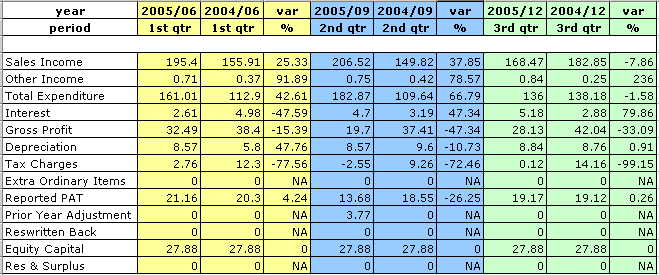
Most investors tend not to look at the notes that come along with each quarterly financial statement. I confess, I am one of 'em. However, after getting some strong advice by Jagadish on the Teledata issue, this is one area i've been trying to evolve in my calculations. A striking example has been seen in the quarterly statements furnished by India Glycols. First impressions may read the following numbers -
- Q1 profits of 21.16 crs this yr v/s 20.30 crs last yr
- Q2 profits of 13.68 crs this yr v/s 18.55 crs last yr
- Q3 profits of 19.17 crs this yr v/s 19.12 crs last yr
Which means, India Glycols is partially short in it's nine month performance numbers (a PAT of 54.01 crs this yr v/s 57.97 crs last yr). At 2,78,80,000 shares (FV of 10 rupees/share), the nine-month EPS should come to 19.42 rupees/share.
Now read notice note no. 4 in the quarterly report - it reads .. "Income Tax liability (excluding deferred tax Rs. 336 lacs) for the quarter works out to Rs. 455 lacs and for the nine months will be Rs. 1208 lacs (excluding deferred tax Rs. 444 lacs). Full year tax liability (excluding deferred tax ) is estimated at about Rs. 629 lacs. Considering the substantial variation in the quarterly Tax provisions, it has been decided to provide for tax (including deferred tax) at the end of the year."
In simpler terms, India Glycols paid a tax of 35.2 crs on a gross profit of 117.4 crs ... i.e. 30.2% tax on PBT. This yr, the 9 month PBT comes to 80.33 crs, which should be a tax of 24.1 crs. So far the company has provided for zero tax. Extrapolating the numbers available, I would estimate the PBT for Q4 at around 35 crs (which is a little over the median). Less depreciation to this at 8.5 cars and the tax at 24.1 crs .... India Glycols should put up a result of just rupees 3 crores as it's quarter 4 PAT.
This is one stock about to take a beating for this !!!
The revised EPS on the basis of this info for the year (all 12 months) should be 20.5 rupees/share. And hence the P/E ratio would be 8.85.
This is a classical example of the things retail investors miss out on.
Bookmark this post: |
|
Tuesday, October 18, 2005
Marketer of a company
Modestly apart, most organizations have started brandishing their quarterly financial staminate with "words of progress" with common use of words like exceptional, superlative, fantastic etc. I picked up an article (read: advertisement) this Friday by Indiabulls which was none short of self-aggrandize. On Sunday, PNB displayed it's annual statements in flying colors - Raising benchmarks, exceeding targets.
These may be great companies but more often than not, the primary reason behind such statements is the increasingly prevalent progression towards a short-term rise in shareholder wealth. As more organizations are looked after by professional management and with a more informed and demanding investor community - maintenance and increase in share prices become inevitable.
My request to all is -
- turn a blind eye to any such messages (by the organization or otherwise). As investors, we should invest by numbers rather than news
- be conservative. Always treat such messages with suspicion (whether they may be right or wrong). Any company worth it's salt (like HLL, ITC, Britannia) will never resort to such practices. The value will speak for itself.
Bookmark this post: |
|