
The complete notes are available at seekingalpha.com (here). I have picked a few interesting points delivered by Charlie Munger at the meeting. (My commentary in blue)
One of my favorite stories is boy in Texas, when the teacher asked the class the following question. There are nine sheep in pen, and one jumps out, how many are left? Everyone got it right, and said eight are left. The boy said none are left. The teacher said you don't understand arithmetic, and he said 'no you don't understand sheep'.
Charlie Munger here, refers to the domino effect where companies tend to imitate others (for quick gain) without an after-thought of the possible effects. This is especially true on account of the recent shakeout of financial companies across the world. In the US & UK, the sub-prime mortgage crisis (owing to mortgage-backed securities) have spelled down for Bear Sterns, Citigroup and Northern Rock (UK). In India, NBFCs like Citifinancial, GE Money (and banks like ICICI Bank) are facing peril at the hands of rising delinquencies in the small ticket segments.
If you are an investment bank and had to be rescued, there should be limits on leverage and the complications of your business. There should be qualitative limits too. By and large banks behaved well when it worked this way. When I was young, Bank of America – would not have done things they do now. Derivative trading, no good clearance, no rules, excess and craziness feeding on itself. The plain vanilla products got priced down to no profits. They wanted to do complicated stuff. Not sure if it cleared, or other side would be good for it. It didn't bother anyone since they wanted the profits .... People talk about marvels of system and risk transfer – but some of our troubles COME from having so much risk transfer.
Regulation has it's place in capitalism. To trust the market to correct by itself and letting ill-run companies die on their own is no longer an option (without jeopardizing the entire financial economy of the country). Munger also makes a point for simplicity and understanding of their actions. When financial corporations issued CDS, they assumed that the risk of default never existed. Firstly, their equity base was too small to bear this risk and secondly, unlike insurance, the risk of default on financial instruments is never random & can bankrupt companies in an instant. Munger also trackbacks to the art of value investing which is much more simpler than most of these alternate investments and often gives more value to the investor.
The only duty of corporate executives is to widen the moat. We must make it wider. Every day is to widen the moat. We gave you a competitive advantage, and you must leave us the moat. There are times when it is too tough. But duty should be to widen the moat. I can see instance after instance where that isn't what people do in business. One must keep their eye on ball of widening the moat, to be a steward of the competitive advantage that came to you. A General in England said, 'Get you the sons your fathers got, and God will save the Queen.'
Munger again captures the essence of value investing - "the art of finding an economic moat and widening it." From Berkshire's point of view, this is what their investments in Coca-Cola, Gillette, Disney, GEICO and NetJet have been - proof of which has been captured in the company's shareholder value.
Saturday, May 10, 2008
Notes from 2008 Wesco Shareholder Meeting

Bookmark this post: | 


|
Friday, April 25, 2008
Visa Steel
PINC Research has given a 1-year target price for Visa Steel : Rs. 85.00.
Here's what the news article in the Economic Times says (here) : At the market price of Rs 48, the stock trades at a P/E of 2.8x and EV/EBITDA of 3x 2009-10 estimated earnings of Rs 16.90.
Given the fact that Visa Steel's 52-week high is Rs.65 ... a Rs. 85 target means the company is doing something outstanding which the markets (and hundreds of analysts) have not eyed thus far. Additionally, the research house is expecting a 75% appreciation in the stock from current levels.
I got curious :-) ... however, a cursory glance of the company's financials seems to offer a very different picture. An independent analysis is enclosed :
Equity capital : Rs. 110 crs
Face Value : Rs. 10 per share
LY profits : Rs. 20.5 crs
CY Profits : Rs. 22.5 crs (last 4 qtrs)
Debt : Rs. 498 crs
EV : Rs. 1041 crs
EBITDA : Rs. 64.68 crs (last 4 qtrs)
CMP : Rs. 49 per share
EPS : Rs. 2.04 per share
PE ratio : 23.9
EV/EBITDA : 16.06
The PE ratio and EV/EBITDA ratio for FY08 are 23.90 and 16.06 respectively. If PINC's earning estimate of Rs. 16.9 per share is correct, VISA Steel has to earn about 8.3 times of what it earned this year. This amounts to Rs. 186 crores of net profits for FY 2009-10.
Visa Steel operates at a net profit margin of 3.7%. Assuming this increases to as high as 5% (given some forwarding looking statements by the VISA Steel management), we are looking at sales of Rs. 3,720 crores for FY09-10 (which is 6.6 times of FY08 numbers). Now, this is the steel industry we're talking about ... sales increases need to be supported by capex increases ... which means more debt, more interest payments, more depreciation etc.
It would be interesting to read their report though. I have a thumbs-down on a Rs. 85 price target. From a value investor's view-point - there seems to be no margin of safety, power franchise or pricing anamoly that can be exploited.
Bookmark this post: |
|
Tuesday, April 8, 2008
Economic Moat
We've heard this term, many times over now. Warren Buffett and his fellow value investors swear by it ... the economic moat finds it's place on page 1 of value investing 101.
Pat Dorsey in his book, The Little Book That Builds Wealth, defines the moat as anything that protects a company's profits from competition and allows the company to earn exceptional returns on capital over long periods of time.
1. Intangibles
Examples of this are a strong brand that allows a business to charge more for comparable items, patent protection on products like drug formulations and technologies, and regulatory licenses that are particularly hard to obtain.
2. High switching costs
This represents the "sticky" customer advantage shared by banks and widely adopted software vendors. Who wants to go through the hassle of transferring an account or training an entire staff on a new piece of software?
3. Network effects
A network effect occurs where the value of a business increases with each node on the network. (refer to my previous post on "Cumulative Advantage"). Dorsey talks about the credit card processors, Mastercard. As more people use it, more new places sprout up that want to accept it; and hence even more people start using it. Another example is eBay - sellers go there because that is where the buyers are, and buyers go there because, you guessed it, that's where the sellers are!
4. Cost advantages
a) Have a better business model like Dell or Southwest Airlines, where the business structures allow you to underprice the competition.
b) Have a better location like having a iron ore mine next to the steel plant reduces transportation and handling cost.
Bookmark this post: |
|
Wednesday, March 26, 2008
The Kelly Criterion
While reading an article over the internet, a certain line caught my attention - "while most of the investment world talks about what stock to buy, no one tells us how much of it should be bought."
I investigated further to find a paper written way back in 1956 by J. L. Kelly Jr. which evaluates "how much" a gambler needs to bet on a table such that he can maximize the growth of capital at a rate which is equal to his information rate over the channel. In other words, how can one achieve the maximum growth in capital for the amount of risk one is taking.
There has been a lot of work around this and is today called the Kelly Criterion. The question that the criterion seeks to answer is : how much of my capital should I allocate towards a trade?
Assume your research has indicated that there is 70% chance that the price of Ranbaxy is going to drop in the next 2 days. Further, you feel that the drop will be a good 12% from it's current price. Just to be on the safer side, you assume that even if the price of Ranbaxy rises, it wont go over 8%.
In other words, your probability of winning is 70%; your probability of losing is 30% and the win/loss ratio is 1.5 (12% divided by 8%).
Kelly % = Prob (winning) - [Prob (losing) / win-loss ratio]
In this case, Kelly % comes to 50% ... i.e. 70% - [30%/1.5]. Thus Kelly's % says that you must not invest more than 50% of your capital towards this trade i.e. shorting Ranbaxy.
Over time, the Kelly % has come under criticism for being too heavy (as in this case, 50%) to allow for easy diversification of portfolio. Most people who use Kellys' have settled for a half-Kelly i.e. 25% as in this case. However, I found the Kelly % quite simple and useful in ensuring that an investor is not putting too much capital into a single trade. So, the next time you run a buy or sell decision, try to measure it's effects using the Kelly criterion.
Bookmark this post: |
|
Monday, February 20, 2006
Change is good
The recent change in conditions at HCL Infosystems is a good example of how any change in the 4Ps (price, place, product, public) can dent or raise a stock's going price.
To illustrate -
Say HCL Infosystems. Upon viewing the Q1 + Q2 data, I find that the change in agreement with Nokia, means the company has dented it's revenue numbers (ceteris paribus) by 40.12%. The new revenue number will be 3041 crores (i.e. 50% of 4074 crs from their telecom business plus 1004 crs from other businesses). The PBT would come to 115.5 crs - a dent of 32.06%. If I were to not question the fact that the HCL Infosystems stock is overly/fairly/under priced, the HCL Infosystems stock should have been at anywhere betwee 32% to 40% i.e. from a price of 259 rupees ... the fall should lie between 155 rupees and 176 rupees.
The stock had an intra-day low of 145 rupees and it closed at 180 rupees. Pricing anamoly.
A more interesting example can be seen in the 2004 HLL-P&G price war where P&G initiated a price war by reducing the price of popular detergents by 25%. As a response, HLL followed suit with a 25% reduction in prices. The P&G scrips were at 405 on the day of the announcement and HLL stock was quoted at 174 rupees.
Surprisingly the P&G stock went upto 433 rupees by the first week of May (see charting) while the HLL stock actually reduced from it's levels by a good 18% till the first week of May (from 175 rupees to 142 rupees; HLL touched a low of 105 rupees on August 16th, 2004).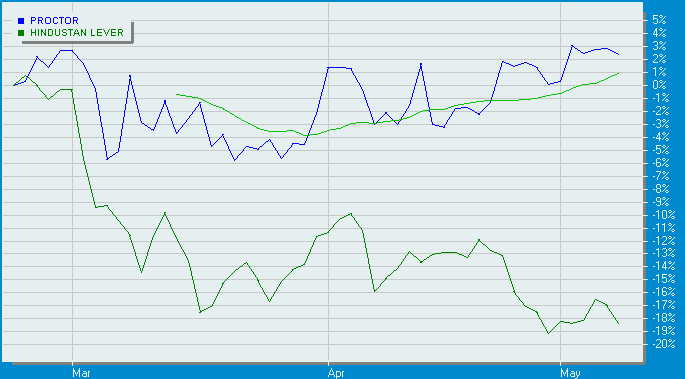
Same industry. Same reduction in price. Same effect to profitability. And yet, the 4th P (public) made a different inference.
But that's not the point .... Analyse this !!!! Detergents contributed only 24% to the total revenue of HLL. Which means the 25% reduction in price should have brought down the revenue by only (25% mult by 24%) ... 6%, but the market actually drilled down the HLL price by exactly the same amount of price cut i.e. TWENTY FIVE PERCENT.
A clear anomaly in understanding "impact on profitability".
Value investors kept on buying this stock as soon as it went below the price of 150 rupees. Easy money. Watch out for such opportunities !!!!
Bookmark this post: |
|
