Over time, the most common measure of a stock's value or cheapness has been a low price-to-earnings ratio (P/E). But many investors who follow this trail often find themselves falling into the "value trap." To quote an old Japanese saying, "Yasukarou, warukarou—what is cheap may also be bad."
In an excellent article, (here) Amit Dugar explores the potential pitfalls of value investing and offers some practical guidance on avoiding the value trap.
An excerpt from the article :
The theory goes, with the cheaper share, investors are buying protection and lowering their risk. While investors expect a lot of future growth from a stock with a high double digit or triple-digit P/E, the market will often trash it at the slightest hint of trouble. On the other hand, the market is signaling it has low expectations for a stock trading at a single-digit P/E. Bad news is likely to have nowhere near the same impact on the low-P/E stock that it would have on the high-P/E one. The theory is that since the market has lower expectations, these stocks are more likely to show positive surprises in the future—with a greater likelihood of above-average returns.
In reality - some cheap stocks are dogs. That's where the value trap comes in. There are lots of examples of former high-flying growth stocks now selling for much lower P/E multiples than in the past. This does not necessarily mean that these stocks are now a good value. They may continue to fall, and may never recover. Without knowing their intrinsic values or possible catalysts for turnaround, you can't know whether they offer good value or not.
Notice the author talks of two important things here - 1. intrinsic value and 2. catalyst. I would like to talk a bit more about the catalyst.
A catalyst refers to an internal or external event (foreseeable or non-foreseeable) which dramatically moves the stock upwards or downwards. While we had explore a similar event like Siemen's one-time provision (post), the essence of a constructed catalyst (i.e. internal) is captured in the following items -
1. LBO (leverage buyouts) : When PE groups buy out publicly-traded companies and subsequently own them privately. The catalyst here is that speculation that certain publicly-traded companies might be ripe for picking by these private investors may increase the market price of their stock. An Indian example of LBO : KKR's acquisition of 85% in Flextronics (article in IHT)
2. Leveraged recapitalizations : are similar to LBO's in that such recapitalizations usually retire sizable amounts of the common stock of the publicly-traded companies involved, by buying it in the in the open market and replacing it with newly-issued debt. Unlike companies involved in LBO's, these companies' stock remains publicly-traded--but, again, speculation that XYZ Co. is going to do such a recapitalization will tend to increase the market price of its stock. My favourite case study on leveraged recap is the one on 'Sealed Air Case' (here)
3. Corporate split-ups : When companies divest part of their structure by giving such parts outright to the original companies' shareholders or selling the parts to other parties. Again, speculation of such deals will tend to drive up the stock price of those companies. There have been many split-ups in recent years with Reliance being the prominent example.
4. Huge stock buybacks : Many companies have been for years buying back their own publicly-traded shares on the open market. Of course, this buy-back activity tends to increase the market value of the stock by increasing the demand of the companies themselves for it. However, the investment community has grown a bit skeptic of buy-back announcement. Enclosed is a news article where UBS didnt term Dell's $10 bn buyback announcement as a catalyst (here)
5. Spin offs : The spin-off of a segment of the company that was not a good match with the rest of the company--is actually promoting future organic growth of the company. A recent Indian announcement was the proposed spin off of it's tower by Tata Teleservices (here).
These catalyst are instrumental in hiking or shunning the price of a share and value picks are no different. For any value stock to come out of a value trap, a catalyst is a must.
Sunday, May 4, 2008
Value Trap

Bookmark this post: | 


|
Saturday, April 26, 2008
Special Situations
Fidelity India runs a "Special Situations Fund". As it's fund update surmises the objectives of the fund (here), the areas identified as special situations include -
1. Turnarounds or recovery situations (underperforming companies with potential for recovery)
2. Underappreciated growth (companies whose growth characteristics have not yet been adequately recognized)
3. Asset plays (companies which sell at a significant discount to their underlying assets)
4. New product or new business streams (companies having a unique product with strong demand potential or opportunities to use existing resources for generating new business streams)
5. Corporate actions (companies which are potential candidates for mergers & acquisitions or where managements undertake significant restructuring of the business)
6. Out-of-favour stocks (unfashionable companies with improving fundamentals)
Incidentally, the Fidelity Fund celebrates it's 2nd birthday today ! Since inception, the fund that given an annualised return of 22.1% and in the last one year, performed at just 12.4%. Diversification doesnt seem to be a strength here as 6 of the top 8 holdings are in the BFSI segment currently. (here)
Siemens India ... a special situation
Siemens announced their Q2 results yesterday. The company's Q2 standalone net profit was at Rs 1.7 crore versus Rs 108.1 crore, YoY. (a drop of 99% !). Its standalone net sales were at Rs 2,142. crore versus Rs 2,129.2 crore, YoY. The reason for the drop in profits was a one-time provision for order reversals.
If the price of the stock gets beaten down on account of this one-time provision, then it might qualify for a special situation. While I am not aware of the amount of this one-time provision - given CNBC-TV18 estimates where the company was expected to post profit after tax of Rs 159.6 crore for this quarter - I shall assume the provision was a strong 157 crores.
The scrip is currently priced at Rs. 644 (April-25). The market is hinting a price drop of 40-50 rupees on account of this news. If that happens, then a perfect sound stock (assuming it is not already overpriced) would be trading 15% below it's fair price.
CNBC-TV18 further sees net sales going up at Rs 2,698 crore versus Rs 2,129 crore and OPM is likely to get improved at 8.4% from 7.6% for Q2. (the sales target was way off at Rs. 2,142 crores only; probably they maintained their previous OPM of 7.6%). In my calculations, a probable 15% drop in prices will not do the PE ratio a lot of good as it will still be over 30. However, the price drop might warrant a short-term gain.
Btw, an interesting presentation rounding Siemens' performance and businesses is available on their website (here)
April 29th : Siemens did fall by 10% and reached Rs. 580 per share. I bought the stock at Rs. 583.
Bookmark this post: |
|
Friday, April 25, 2008
Visa Steel
PINC Research has given a 1-year target price for Visa Steel : Rs. 85.00.
Here's what the news article in the Economic Times says (here) : At the market price of Rs 48, the stock trades at a P/E of 2.8x and EV/EBITDA of 3x 2009-10 estimated earnings of Rs 16.90.
Given the fact that Visa Steel's 52-week high is Rs.65 ... a Rs. 85 target means the company is doing something outstanding which the markets (and hundreds of analysts) have not eyed thus far. Additionally, the research house is expecting a 75% appreciation in the stock from current levels.
I got curious :-) ... however, a cursory glance of the company's financials seems to offer a very different picture. An independent analysis is enclosed :
Equity capital : Rs. 110 crs
Face Value : Rs. 10 per share
LY profits : Rs. 20.5 crs
CY Profits : Rs. 22.5 crs (last 4 qtrs)
Debt : Rs. 498 crs
EV : Rs. 1041 crs
EBITDA : Rs. 64.68 crs (last 4 qtrs)
CMP : Rs. 49 per share
EPS : Rs. 2.04 per share
PE ratio : 23.9
EV/EBITDA : 16.06
The PE ratio and EV/EBITDA ratio for FY08 are 23.90 and 16.06 respectively. If PINC's earning estimate of Rs. 16.9 per share is correct, VISA Steel has to earn about 8.3 times of what it earned this year. This amounts to Rs. 186 crores of net profits for FY 2009-10.
Visa Steel operates at a net profit margin of 3.7%. Assuming this increases to as high as 5% (given some forwarding looking statements by the VISA Steel management), we are looking at sales of Rs. 3,720 crores for FY09-10 (which is 6.6 times of FY08 numbers). Now, this is the steel industry we're talking about ... sales increases need to be supported by capex increases ... which means more debt, more interest payments, more depreciation etc.
It would be interesting to read their report though. I have a thumbs-down on a Rs. 85 price target. From a value investor's view-point - there seems to be no margin of safety, power franchise or pricing anamoly that can be exploited.
Bookmark this post: |
|
Wednesday, April 16, 2008
'Value Investing' by Prof. Greenwald
Professor Bakshi has uploaded Professor Bruce Greenwald's notes on his website (here). Prof. Greenwald from the Columbia Business School, was in Mumbai to deliver a talk titled, "Value Investing Frameworks and Business Analytics" (post by Prof. Bakshi)
In an article published in The Motley Fool, Prof. Greenwald shared his learning in a 5-part series. I've enclosed some parts of these in the post.
Part 1 : VALUE INVESTING 101 (here)
1. Simple stock search strategy : go for ugly, traded-down, cheap, boring -- as opposed to glamorous, respectable, lottery-ticket type and prominent stocks.
2. Develop a valuation technology : The Graham technology is starting with the most reliable information, which is asset value, then looking at the second-most reliable information, which is current earnings -- with all the appropriate adjustments and getting an earnings-power value -- and then looking at those two and see what they tell you about the extent to which you are buying a franchise, which is value in excess of assets. And then, only then, looking at the growth.
3. Patience : You have to have confidence in your valuation. If nothing has changed about the underlying value of the company, then if it's a good stock at 8, then it's a better stock at 4.
Part 2 : TO HOLD CASH OR NOT? (here)
4. Valuations may be high but in general, don't just throw away the market : If you're an equity manager - what's your risk? It's deviation from the market. So if you have nothing to do, you might as well minimize risk and buy a full market portfolio, and that's that.
5. Determine your risk tolerance : Look at it this way, if you're being given institutional funds that the institution wants to allocate to equity, you got a different risk profile on the returns on those funds than if you're managing a family's entire wealth where they care about absolute returns.
Part 3 : THE ART OF SHORTING (here)
6. One of the most restrictive clauses of the value discipline is 'no short selling' : Value investors are nervous about short selling for two reasons.
a) Tax treatment of short gains
b) As the stock goes up and the short goes against you, your risk goes up as opposed to going down. (I think the professor means that as the price of the stock goes even down, your opportunity should increase such that you can accumulate more. But you are on a long position and when the stock goes down, the shorting turns the advantage into a loss).
7. In shorts, much more than longs, you obviously want to look for a catalyst : This can be a restructuring or an earnings disappointment etc.
Part Four : IDENTIFYING FRANCHISES (here)
8. The way to think of growth in the simplest possible terms is growth requires investment : Everybody on Wall Street sort of talks about scalability and growth without investment, but if you look at the history of any growing firm, the amount of capital they put in grows with the growth in the firm. It just tends not to be scalable.
9. A franchise : is something that you can do that your competitors can't. And there are really only three possibilities.
a) It is increasingly rare in a rapidly changing world is that I've got technology that they can't match. That I can do it at a lower cost than they can. Those things go away very quickly, because people can copy technology. It's usually only in very complicated process industries that you have -- and some pharmaceuticals where you're patent protected, that you have technological advantages.
b) Customer captivity is probably going down a little. The Internet makes it very easy to compare prices. It's the enemy of profitability in that sense. But if you look at repeat purchase behavior, it probably hasn't changed all that much.
c) Can't match my cost, even though they've got the same cost structure, because I have economies of scale and they don't.
Part 5 : THE ONE INVESTOR TO BET ON (here)
10. If I were going to start off as an investor, I would start with Ben Graham's book, The Intelligent Investor. It's not because he lays out all the really good ideas that he had perfectly, but it's just a terrific introduction to the attitude it takes to be a successful investor.
Bookmark this post: |
|
Thursday, April 10, 2008
ICICI Direct stock picks
My yahoo mail account gleefully popped out the latest ICICI Direct recommendation list. (here) Over time I've observed that the ICICI Direct stock picks are pretty efficient and 80% of the times, give the right result (read: positive). Since some of these recommendations were given in Feb and Mar, I updated the prices and sorted the list to identify their best picks for mid-term investing (12-15 months). The new chart is enclosed below.
Click on the picture to enlarge

The column in the extreme right indicates what happens if you were to put up 10,000 rupees against each stock and follow the published time frame of 12-15 months. If the picks were right then you would end with a return of 48.7%.
This allows room for some sensitivity. Lets assume that 70% of the picks will be right i.e. when the price reaches the target, we will sell the stock at that price. Correspondingly, for the 30% picks that'll go wrong, lets assume zero price appreciation over time.
Case 1: Our top 3 stocks (sorted by appreciation) go wrong ... In this case, our 15-month return will only be 24.4%
Case 2: And if our bottom 3 stocks (sorted by appreciation) go wrong ... our 15-month return will be 42.7%
Hence, our range of 15-month returns on the basis of ICICI Direct recommendations lies between 24.4% to 42.7%.
Instead, had we just picked the top 5 stocks from this list, our returns estimate jumps up to 69.0%. Correspondingly, the returns range would hover between 34.1% and 48.6% on the basis of a 60:40 right-wrong ratio. An average return of 40% on the Indian equity market factoring a 30% wrongness factor isn't bad, eh?
Bookmark this post: |
|
Monday, April 7, 2008
Imitation is the best form of flattery
Millions have tried to learn from Warren Buffett - the undisputed guru of investing. Of this bunch of hopefuls, a handful of them have benefited from his wisdom, read books and have created their millions by putting his principles to practice (and executed them well).
Which should kinda make you wonder - "So, if this man is as good as people say he is - then why not just copy his strategies and make my first million"
In a recent study, professor Gerald Martin studied the results of just that.
His premise was very simple - "If I didn't have to do any research himself and just copied Buffett’s trades a month after the trades are disclosed to the public - will I end up making any money?"
The results were quite flattering (imitation being just that ... hmm). The professor's plagiarized portfolio would still have managed to beat the S&P 500 by more than 14% a year over the same period of Buffett's investment. (article here)
The period under consideration is not given but I wont be surprised if the professor is talking about 20-30 year periods. Hence, for this stock-picking technique to be successful .. you should not only invest in what Buffett picks (one month prior to you) but also have the discipline of holding out to that portfolio as long as he does it.
Bookmark this post: |
|
Friday, March 28, 2008
iRules
I came across a splendid article on Rule Maker Criteria, which put forward certain rules to stock investing. These rules are enclosed. I have further tried to explain each of these below.
1. Sustainable competitive advantage
2. The company must be dominant in its given industry
3. Dominant for more than a decade
4. Cash King Margin in excess of 10%
5. Foolish Flow Ratio below 1.25
6. Sales above $4 billion per year and growing revenues at 10% plus rates
7. Great management
8. Return On Invested Capital above 11%
9. Cash no less than 1.5 times debt
10. A reasonable purchase (or holding) price
If you find any company in India, that fits the profile .. pls use the comments column to this further. Or feel free to email me.
1. Sustainable competitive advantage
This includes companies which are sheltered from competition, powerful brands, patents, monopolies and unduplicable distribution systems. This is where you look at possible threats to a company, something which often companies themselves fail to list in their management discussion and analysis pages. E.g. BillPay's 3000 outlet distribution network is in risk of mobile bill payments, newspaper's advertising revenue replaced by online advertising etc.
2. A dominant company
The higher the market-share (and mind-share) of the company, the better positioned it is. E.g. Naukri or Monster for job searches, CRISIL for ratings, IIM for management education.
3. Dominant for over a decade
This is quite self-explanatory. Maruti Suzuki is a good example that comes to mind. (discounting the Nano effect for now)
4. Cash margin in excess of 10%
Pls notice that it reads cash margin, and not net margin. If a company's free cash flow is over 10% of it's revenue, then it warrants more investigation. FCF is quite a weapon: money that it can either reinvest or return to shareholders. Some businesses, such as many types of retailing, will not allow such margins but most others do. FCF is calculated by taking the cash from operating activities and subtracting it by capital expenditure for the year.
5. The Flow Ratio
Let me explain the background behind the ratio first. A 'flow ratio' represents how well a company is managing it's cash. This is applicable to individuals aswell, like you and me. It's like saying, we are more comfortable when our debtors paid their dues, and we still have a few days left before we pay our creditors. For us, as investors, a company that does that has a lot of breathing space and gives us more comfort.
As a formula :
Flow Ratio = (Current Assets - Cash - Cash equivalent - Marketable securities) divided by (Current Liabilities - short term debt - current portion of long-term debt)
So, if this ratio is below 1.25 - the company is comfortably placed around managing it's cash.
There is one part of this principle that I dont quite understand. Let me take an example here. Sales = 100; Cash = 5; CA = 30; ST debt = 5; CL = 35. Here, the flow ratio comes to 0.83. But, I am not still not comfortable with the fact, that 30% of my sales for that year has been accrued but I have not yet received the cash. This is similar to the inventory turnover ratios, which also warrants a look while understanding a business.
6. Sales above USD 4 billion per year and growing at 10%
This is absolutely upto you. Since I prefer to invest in mid-cap companies, my minimum annual sales benchmark is Rs. 300 crores (USD 75 million). However, the annual growth of my companies is a much stricter 25% of organic growth. (organic doesnt include revenue increase from any acquisitions or mergers)
7. Great management
Fisher's insights into management revolved around - unquestionable integrity, commitment to new product development, outstanding labor and personnel relations, outstanding executive relations, managerial depth, long-range outlook on profits and open communication with investors.
8. Return on capital invested over 11%
This is a way of saying, does it make sense for me to put this capital in this business or just stash it in a fixed deposit that can give me 9.5% pre-tax. 11% (post tax) is definitely one-up on a risk-free investment or fixed deposit. Some pundits settle for nothing less than 15%.
9. Cash to debt should be 1.5 or higher
Businesses like this carry a huge moat with them. These are cash rich companies which can produce earnings using internal accruals rather than borrowing from the market. Such companies are difficult to find. The IT sector would have a few of them though.
10. A reasonable price
As a thumb rule, dont pay a price more than 60% of the intrinsic value of the business. I would agree to this rule. 40% is a good margin-of-safety ... and a brilliant price to pay for a good business.
Value investing requires discipline. I would suggest all to make a rule list for yourself and examine businesses in the light of these.
Bookmark this post: |
|
Wednesday, March 26, 2008
The Kelly Criterion
While reading an article over the internet, a certain line caught my attention - "while most of the investment world talks about what stock to buy, no one tells us how much of it should be bought."
I investigated further to find a paper written way back in 1956 by J. L. Kelly Jr. which evaluates "how much" a gambler needs to bet on a table such that he can maximize the growth of capital at a rate which is equal to his information rate over the channel. In other words, how can one achieve the maximum growth in capital for the amount of risk one is taking.
There has been a lot of work around this and is today called the Kelly Criterion. The question that the criterion seeks to answer is : how much of my capital should I allocate towards a trade?
Assume your research has indicated that there is 70% chance that the price of Ranbaxy is going to drop in the next 2 days. Further, you feel that the drop will be a good 12% from it's current price. Just to be on the safer side, you assume that even if the price of Ranbaxy rises, it wont go over 8%.
In other words, your probability of winning is 70%; your probability of losing is 30% and the win/loss ratio is 1.5 (12% divided by 8%).
Kelly % = Prob (winning) - [Prob (losing) / win-loss ratio]
In this case, Kelly % comes to 50% ... i.e. 70% - [30%/1.5]. Thus Kelly's % says that you must not invest more than 50% of your capital towards this trade i.e. shorting Ranbaxy.
Over time, the Kelly % has come under criticism for being too heavy (as in this case, 50%) to allow for easy diversification of portfolio. Most people who use Kellys' have settled for a half-Kelly i.e. 25% as in this case. However, I found the Kelly % quite simple and useful in ensuring that an investor is not putting too much capital into a single trade. So, the next time you run a buy or sell decision, try to measure it's effects using the Kelly criterion.
Bookmark this post: |
|
Sunday, January 13, 2008
Tips !
A friend recently recommended the scrip Syschem (India). As I dont believe in tips, I made a 10-min research on the company. The company does about 4 crores of sales and about 40 lakhs of profits. In the last three quarters, two have been negative. The m-cap of the stock is 40 crs and the current price is Rs. 3.62. BSE has categorised this stock as 'T'
And just when I thought most people will pass on this stock, I saw the avg qty on bseindia ... 2 wk avg of 2,405,548 shares ! I peeked through moneycontrol ... here are the entries :-)
Posted by: mohitjohri on ( 09-Jan-08 16:06 ) Price : BSE: Rs 3.66 ( 3.68 % )
sir i hv purched 10000 shair @ 3.61 ...sir plz sages .. .wt ,s tha targ plz confarm me
Posted by: Guest on (10-Jan-08 07:25 ) Price : BSE: Rs 3.66 ( 3.68 % )
i have more then 50000 shares. insallah you will see 10+ shortly but i would recommand to hold certain percentage of your profit for almost a year & you will get 100+.you have got the right thing.
Posted by: vino1983 on (10-Jan-08 21:02 ) Price : BSE: Rs 3.71 ( 1.37 % )
syschem india is a awsome stock which will be in limelight in a very short future.
it has a good scope. will reach 10rs before mid feb 2008. might still go up till 15 - 16 by end of feb. i hold 74500 stocks @ 3.69. my friend who is working for a stock broking firm holds 235000 stocks at a average price of 3.03. good luck. invest and reap very good returns.
Bookmark this post: |
|
Wednesday, May 31, 2006
More ... sasta stocks
My picks for tomorrow will be :
1. Rane Engine Valve - small cap; should give quick money .. 15-16% in a week; stop loss at 320
2. Wockhardt - good stock at low price
3. Monsanto - At a PE of 13 and an expected PAT of almost 100 crs ... easy buy
4. Apollo Tyres - quick money; stop loss at 220
5. Balaji Telefims - Good NCAV; good PE for entertainment/media stock
6. Abbott India - sasta
7. NIIT Technologies - sasta; buy and hold
8. Fag Bearing - quick money stock
9. Rain Calcining
10. Madras Aluminium Co.
11. India Glycol - has upside; a PE of 7.02
12. Apar Industries - Excellent sales growth; long-term prospect
13. Aegis Logistics - Great sales growth; good traction; quick money
14. Gujarat Ambuja Export - brilliant PE though sales are slow
15. NOCIL - excellent turnaround story
16. Tinplate Co. of India - Amazing valuations
17. Ind Swift Labs - One of the cheaper pharma scrips
18. Ahmednagar Forging - Forget the zero dividend; has a debt-reap of 64% of m-cap
19. Andhra Pradesh Paper Mills - Amazing valuations
20. Jupiter Biosciences - Future growth story
Bookmark this post: |
|
Wednesday, May 24, 2006
Sasta stocks
This is all I've been listening and reading over the last two days. A friend at office tried an experiment on this - he picked ten random stocks given in the tabloids as ridiculously cheap stocks ... surprise !!! ... that herd of "cheap" stocks actually knoocked off 3.4% of an investors wealth in the last two days.
What did I do? I too bought some stocks on 22-May (when the mkt went down by 1000 pts). As I had only 80000 bucks, I divided the money among some 9-10 stocks. Here are my value picks -
a) Amtek India - I bought this again ... at 108 rupees. It's at 120 today.
b) Bank of Baroda - Bought at 227 rupees ... up to 239 rupees
c) Kalpatru Power - Amazing returns ... bought at 641 .... now up to 755 rupees
d) Mastek - up from my buy price of 307 .. up to 326 rupees
e) Rolta India - Bought at 184 rupees. Now at 194 rupees
f) Gujarat NRE - Bought a little more ... at 65 rupees ... its up to 75
g) Rain Calcining - 38 rupees .. 39.10 rupees
h) Tinplate Co of India - 73 rupees goes up to 77 rupees
i) Alembic - 328 rupees .. disappointing up to only 332 rupees
j) Alok Textiles - bought at 73.5 rupees ... at 77.15 rupees
I had my share of fun today .. the BSE fell by 250 points today ... and my portfolio actually went up a miserly 0.4%
Bookmark this post: |
|
Sunday, April 30, 2006
Mutual funds and stock valuation
Its often a good idea to see what mutual funds are buying or selling these days. This helps you predict stocks which have a higher propensity of taking the dive or perhaps, soar the skies. I used MutualFundsIndia to list the top 4 performing funds over the last 3 months .. here's their list -
1. Deutsche Alpha Equity Fund - 37.35% in last 3 months
2. Sundaram Select Mid-cap Fund - 33.10% in last 3 months
3. SBI Magnum Comma Fund - 32.90% in last 3 months
4. Franklin India Opportunity Fund - 32.10% in last 3 months
Now, I guessed that the portfolio composition of all these 4 funds would tend towards parity or perhaps, a high correlation. If not companies, atleast the sectors. Here news -
1. Deutsche Alpha - Diversified (29%); Computers (9%); Metals (8%) ... top 3 cos: Sterlite (8%); Tata Steel (8%); Tata Chemicals (7%)
2. Sundaram Midcap - Engineering goods (17%); Housing (11%); Auto & ancillaries (11%) ... top 3 cos.: Kalpataru (4%); Balrampur Chini (4%); Ansal (3%)
3. SBI Magnum - Cement (14%); Diversified (13%); Metals (12%) ... top 3 cos: Hindustan Zinc (8%); Shree Cement (7%); United Phos (5%)
4. Franklin - Entertainment (22%); Auto & ancillaries (14%); Diversified (11%) ... top 3 cos: TVS Motors (9%); Jaiprakash (7%); Calcutta Electric Supply Co. (7%)
Amazingly ...
i) The top three sectors among the four top performing funds is strewn over 8 different industries (from a max:12)
ii) The top 3 holdings of each of the 4 funds is different i.e. we have 12 different companies that form the top 3 holdings of these 4 funds.
iii) The average holding in equities from the total corpus is a healthy 94%. (so you might want to rethink your idea of staying 60% in cash and rest in equity)
Mutual funds donot think alike and have different priorities and basis of evaluating stocks. For us the advantage is in identifying changes in portfolio in mutual funds to understand what they are buying or selling, researching the same and arriving at a decision.
PS: Has anyone checked the Calcutta Electric ... ???
Bookmark this post: |
|
Tuesday, March 14, 2006
Fantastic P/E ratios ( .... low, figuratively !!! )
You might want to research some of these stocks. They have a fairly good market capitalisation and a rather strong P/E ratio amongst their industry peers. I found these in some old files .. seems to be January 2006 data.
I have marked the ones which have shown increasing Q-on-Q profits over the last three quarters in green for your reference. We'll evaluate these over the next two weeks.
Madras Aluminium [12.58]
Pheonix Lamps [10.78]
Pricol [10.58]
Eicher Motors [2.78]
Ashok Leyland [13.48]
Punjab Tractors [10.86]
Bank of Baroda [12.17]
Federal Bank [5.65]
SBI [10.02]
Jupiter Biosciences [6.65]
JK Lakshmi Cement [10.11]
Everest Industries [9.33]
Gujarat NRE Coke [7.42]
India Glycols [6.17]
Savita Chemicals [9.35]
Jaiprakash Associates [13.02]
Nava Bharat Ferro [6.45]
Havell's India [17.09]
LG Balakrishnan [16.09]
Kirloskar Oil Engines [6.50]
GNFC [6.59]
GSFC [6.25]
Mangalore Chemicals [5.85]
GAIL [9.86]
Mascon Global [11.79]
Tata Elxsi [19.22]
Tinplate [5.30]
Adani Export [12.46]
Atul [12.35]
Dredging Corporation [11.79]
Gujarat Alkalies [4.84]
MIRC Electronics [7.23]
Su-Raj Diamonds [7.95]
LIC Housing Finance [9.34]
Shriram Transport [8.42]
Tata Investment Corp [8.90]
ONGC [11.07]
JK Paper [7.97]
West Coast Paper [7.11]
Rallis [9.38]
IPCL [5.30]
Ind Swift Lab [8.18]
Aarti Drugs [9.06]
Merck [11.99]
Shasun Chemicals [13.71]
Torrent Power SEC [8.73]
Infomedia [8.14]
Bongaigoan Refineries [7.00]
Chennai Petro [5.14]
Mercator Lines [4.82]
Varun Shipping [5.77]
Bhushan Steel [4.30]
Monnet Ispat [6.40]
Essar Steel [1.58]
Lloyds Steel [1.78]
Mukand [2.61]
SAIL [4.15]
Mawana Sugar [12.51]
Avaya Global Connect [13.94]
MTNL [10.96]
Alok Industries [10.74]
Nahar Export [6.56]
KEC International [4.58]
Apollo Tyres [14.96]
Bookmark this post: |
|
Friday, March 10, 2006
Stock picks by Stockpaisa.com
Stockpaisa.com has given it's list on price targets in it's website. The list has been worked keeping positive ripples from the budget into perspective and the technicals / fundamentals of the company.
The top five in the list with expected returns over the next 3-5 months are -
1. Venus Remedies - 61%
2. GM Breweries - 58%
3. Areva T&D India Ltd. - 54%
4. Astra Microwave Products Ltd. - 49%
5. Flex Industries Ltd. - 49%
Let's examine a few of them in this post -
1. Venus Remedies
VR is not a Grahamian stock, by a long shot. It's NCAV is at 5.76 while it's CMP is at a fairly high 363.00 rupees per share. With a dividend yeild of 0.28%, I was kinda wondering what makes this stock command such a high valuation. That was when the news element of the stock bundled me ....
a) 12-Dec: VR in talks with MNCs over drug licensing (Cephalosporins combination)
b) 15-Dec: VR has appointed a senior scientist
c) 16-Dec: VR sets up wholly owned subsidary in Germany
d) 27-Dec: VR broad bases Board
e) 3-Jan: VR filed third PCT International Application
f) 17-Jan: Venus Remedies up on Q3 (we'll examine this aswell)
g) 31-Jan: VR acquires pharma unit in Germany
h) 20-Feb: VR filed fourth PCT International Application
i) 8-Mar: VR to consider issue of FCCB
Financially, here's where the company stands -
a) On profits - LY profits were a miniscule 4.1 crs. However this year has been a different story. Q1+Q2+Q3 profits currently stand at 10.81 crs. Extrapolating the numbers, the profit for the year should be on around 16 crs. Which means an EPS of 24.96 rupees/share.
b) The fwdP/E of the stock is at 14.54 which is fairly lower than other emerging pharma companies
c) Sales are going at a doubly pace (a bit more than that) ... LY sales were at 30.83 crs while this year (in 3 qtrs), the company has reached 62.06 crs. At this scoring rate, the company should close at around 90 crs of sales for this FY.
Now, what makes me think again ....
a) All this news ... where did this come from? You might want to read the announcements in BSE. Venus Remedies has close to 50 announcements at the BSE in the last 365 days. (Dr. Reddy's had around 60 announcements in the same period)
b) There is no margin of safety in the stock for comfort. At an NCAV of 5 and a book value (LY) of 23.55 rupees per share ... a CMP of 363 would mean .... (both LY numbers)
1. P/BV ratio of 15.41 and,
2. P/Sales ratio of 7.5
c) And ofcourse, you know my disapproval to any stock who would not give me 10 crs of profit to the quarter. VR is well below that mark.
However, this is not to dissuade you from purchasing the stock as a not-that-far-feteched-bet. The big question is ... when to buy and how does this stock move. Answers to this can be obtained from the charting given below. Interesting trends, these ...
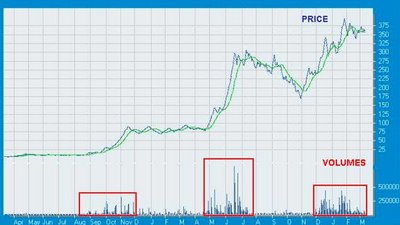
The stock first started moving in the September of 2004. It moved for 4 months (till Dec 2004), post which the stock was silent for 5 months. Again in May-2005, huge volumes moved up the stock to touch 300 rupees per share. This continued for 4 months (till July 2005), post which a lull set in for another 5 months. Another spurt has been seen this Dec onwards. It's been on for Jan, Feb and Mar ... 4 months again. What's your take for the next 5 months?
Bookmark this post: |
|
Thursday, February 16, 2006
Overheated stock and the 20-day test
Three weeks back, I picked out a set of 24 stocks in order to arrive at certain patterns on overheated stocks (i.e. stocks to avoid now - which is as important as picking up the right ones). The list of 24 were on the basis of the biggest movers of the month and necessarily with an m-cap of 500 crs and above.
The following measures were estimated on the basis of the data available -
a) Profit for FY 2005-06 (on the basis of 3 quarters of results)
b) CMP of the stock on Jan 28th 2006 and as on 17th Feb 2006 (to calculate the fwdPE and movement in share price over the 20 day period)
The list is enclosed for your persual -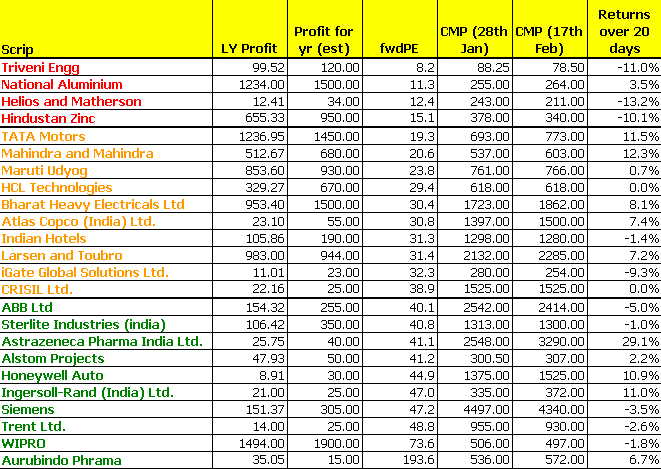
Some interesting patterns were observed.
1. Of the 10 stocks (out of 24) which had a P/E of over 40 - surpisingly only 5 stocks fell over the last 20 days, while 5 stocks actually gained thereby pushing up the fwdPE of the scrip. Shockingly, the ones that fell were within the 0-5% band while the ones that rose grew at ... 10.9%, 6.7%, 11.0% and a huge 29.1%.
2. Of the 10 stocks between a fwdPE of 20 to 40 - only two stocks went down, 6 of 'em went up while 2 remained at status quo.
3. Surprisingly, of the 4 stocks whose PE is well below the market P/E - THREE have actually performed worse at reduction in value of 13.2%, 10.1% and 11.0%.
It's as if, the market is punishing companies which are available at ridiculously low P/E and actually rewarding companies which exhibit a higher P/E.
Is this the elated Mr. Market at his very best?
We need some answers here ... fast !!!
Bookmark this post: |
|
Thursday, February 2, 2006
How to read a company - Hindustan Constructions
This time round, I shall not be listing down the brief stats of the Hindustan Construction Company. For, when I sat down to read the company numbers on ICICIdirect .... a number of things caught my eye which often get missed when our world is around P/E ratios, m-cap, 52 wk H/L etc. You can view the ICICIdirect research section for all numbers on the company. Here's the link.
My observations -
a) The co. has a rather heavy loan amt in its books - 425.68 crs. The financial expenses incurred for servicing this debt was 54.19 crs. This becomes interesting when you observe that the company has been increasing it's debt input every year .. even more interesting when compared with the interest paid in servicing these debts under "financial expenses" in the P&L
statement.
2002 - Loan : 322 crs; Interest : 30.58 crs; Servicing : 9.50%
2003 - Loan : 379 crs; Interest : 50.90 crs; Servicing : 13.41%
2004 - Loan : 419 crs; Interest : 48.11 crs; Servicing : 11.47%
2005 - Loan : 425 crs; Interest : 54.19 crs; Servicing : 12.73%
Questions - Why does the loan rate increase in 2003, 2004 when the borrowing rates were it's lowest ever?
b) Look at the tax charges. You might find it unbelievable !!!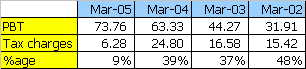
In March 2002, the company paid a tax charge of 48% on the profit before tax (PBT). In March 2005, the company paid just 9%. Two extremes.
c) Investments for FY2005 are placed at 189.92 crs. An analysis of the investments schedule in page 16 of the annual report reveals -
1. A significant portion of the investments (approx 51 crs) have been apportioned with Lavasa Corp. Ltd. - a 50% subsidiary of HCC.
2. Their exposure in MF is 130.74 crs and in a few equity shares of other companies. An interesting aspect was that a share like Hindustan Oil Exploration Ltd. (104400 shares) they hold is accounted at rupees 10 in their books while the CMP (31-Jan) in the market is 1342 rupees. The total (MF plus shares) is at 135.81 crores.
d) The company holds a cash balance of 3.81 rupees per share, so the dividend for the year can be as high as 90 paise. That will mean a dividend yield of 0.69%. This is low.
e) Q1, Q2 and Q3 for the company have been extremely good. Together they have closed at 81.3 crs. The big job is to predict the income numbers for Q4. Some points here -
1. As mentioned, financial charges for FY2005 was 54 crores. However in Q1, Q2 and Q3 of this year (all put together) only 32.8 crs have been accounted. So a huge chunk of 23-25 crores will be used in Q4.
2. Tax charges - Q1 plus Q2 plus Q3 equals only 10.7 crs. Even if I assume a tax charge of only 20% on PBT, I am looking at a tax of atleast 19 crs for Q4.
3. Extrapolating numbers (Q4 has been the best for HCC over the last two years), I would work out the PBIT to 58 crs. Cut an interest of 24 crs and a tax charge of 19 crs, my understanding of PAT should be 15 crs. Which would close the year for HCC at:
- PAT: 96.25 crs (a growth of 26% over LY)
- P/E: 35.51 (at todays CMP)
There is one important rule that Graham has always said (read: Intelligent Investor), "if you cant read the annual report of the company then you have no place in researching and investing in a stock. You are better off giving it to a mutual fund"
On reading the annual report (FY2005), I found the following statements you would be interested in -
1. This will confuse you ... on page 5, to the profit after tax, the management has added "Excess Tax Provision of earlier years written back" (and we here are discussing that the company is not paying enough taxes)
2. The total balance value of work on hand as on March 31, 2005 is Rs. 5381 crore including CompanyÂ’s share in the Integrated Joint Venture Projects.
The latest news item (Jan 24th 2006): "Hindustan Construction Company Ltd has informed that the Company has been awarded a contract for Rs 3,959 million from National Hydroelectric Power Corporation Ltd, Faridabad for Civil Works Package (Lot-I) (Construction of Diversion Arrangement, Concrete Gravity Dam Along with Spillway, Roller Compacted Concrete (RCC) Dam, Intake Structure, Surface Power House, Tail Race Channel, Switch Yard and Other Associated Civil Works) of Teesta Low Dam HE Project, Stage-IV (4x40 MW), West Bengal."
I took up this stock as a study of "how to read a company". However, the writing on the wall says : Is 149 rupees a good price to pay for this stock?
Bookmark this post: |
|
Thursday, January 12, 2006
He wants stock "tips"
Mohit had recently posted a comment in one of my previous blog with a suggestion for me to start posting some stock related pieces. So let me try my hand in proposing some stocks to invest in. But there are some rules - a) All stocks suggested will be based on the principles of value investing and b) all investors who consider the advice must use their own research before ariving at the final decision.
I would attempt to take this blog to be an investor's shack where all can sip a brew of value investing and run down numbers and suggestions to grow the network. True to self, I would still take time to put down some very relevant insights that are listed in some of the great books of our time. (I have started reading "The Intelligent Investor" by Benjamin Graham)
So sit back and enjoy the ride ...
Bookmark this post: |
|
Monday, January 1, 2001
Archives
Companies mentioned in this blog :
Abbott India
Abhishek Industries
Aftek Limited
Albright Wilson Chemicals India Limited
Alembic Pharma
Amtek India
Andhra Cement
Andhra Pradesh Paper Mills
Birla Corp Limited
Bhagyanagar India
Bimetal Bearings
Cheviot Company Limited
Eastern Silk
Electrosteel Castings
Elgitread India
FCS Software
Fem Care Pharma
Graphite India
GNFC Limited
GTL Limited
Gujarat NRE Coke
HCL Infosystems
HEG Limited
Helios and Matheson
Hexaware Technologies
Hindustan Constructions Company
Hotel Leela Ventures
ICSA India
India Glycols
India Nippon Electricals
Ind Swift Labs
Investment and Precision Castings
Jai Corp
JK Paper
JSW Holdings
KRBL
Lloyd Electric and Engineering Limited
Lok Housing and Constructions Limited
Macmillian India
McDowells Holding Limited
Merck Limited
Micro Inks
Motherson Sumi Systems Limited
Motilal Oswal Financial Services
MRF Limited
Mukand Limited
Munjal Auto
Nahar Export
Nahar Industrial Enterprises
NIIT Technologies
NOCIL
PNB Gilts
Polaris
Prajay Engineers Syndicate
Pricol Limited
Pyramid Saimira
Rain Calcining
Ruchi Soya Industries
Sandesh Limited
Sarda Energy and Minerals Limited
Satyam
Savita Chemicals
Sical Logistics
Siemens India
SKF India
SRF Limited
Star Paper
Sundaram ClaytonSu-Raj Diamonds
Teledata Informatics
Titan Industries
Torrent Power SEC Limited
Unichem Labs
Vardhman Holdings
Videocon Appliances
Visa Steel
Visualsoft Technologies
West Coast Paper Mills
Bookmark this post: |
|